


Some candidates prefer to keep their preparation private, and GuideTorrent respects that completely. A strict information protection system keeps every Microsoft Security, Compliance, and Identity Fundamentals (SC-900日本語版) purchase secret and safe, so your SC-900日本語 exam details are never shared with anyone.
Microsoft SC-900日本語 Exam Syllabus Topics:
| Section | Weight | Objectives |
|---|---|---|
| Topic 1: Describe the capabilities of Microsoft security solutions | 30-35 | - Describe Microsoft Defender for Identity
|
| Topic 2: Describe security, compliance, and identity concepts | 10-15 | - Understand identity concepts
|
| Topic 3: Describe the capabilities of Microsoft Entra | 25-30 | - Describe access management capabilities
|
| Topic 4: Describe the capabilities of Microsoft compliance solutions | 20-25 | - Describe privacy and regulatory compliance
|
SC-900日本語 Exam FAQ: Formats, Facts, and Privacy
Whichever matches your habits — all three are built around the same Microsoft Security, Compliance, and Identity Fundamentals (SC-900日本語版) content. The PDF version suits paper readers: print it out, mark it up, and share pages with a study partner. The PC test engine suits computer-based learners: it simulates the real exam scene, lets you set a time limit like the live SC-900日本語 exam, flags your mistakes, and reminds you to re-practice them daily. The online APP includes every software function and runs on Windows, Mac, Android, and iOS. Choose the one you will actually use every day.
The SC-900日本語 exam contains 40-60 questions to be completed in 45-60 minutes. That pace is exactly what the PC test engine's timed mode trains — set the same limit in practice, and the real clock stops being a surprise.
Microsoft recommends these training options for candidates:
Official courses build understanding; a daily practice routine with expert-verified answers builds exam-day readiness. The strongest preparation uses both.
To pass the SC-900日本語 exam you need 700 (out of 1000), and registration costs $99 - $165 USD (varies by region). Set against that fee, thorough preparation is the smaller expense by far — and the one most likely to protect the larger one.
The official outline divides the SC-900日本語 exam into weighted domains, including:
- Describe the capabilities of Microsoft security solutions (30-35)
- Describe security, compliance, and identity concepts (10-15)
- Describe the capabilities of Microsoft Entra (25-30)
The Microsoft Security, Compliance, and Identity Fundamentals (SC-900日本語版) practice questions at GuideTorrent follow these same objectives, whichever of the three study formats you use.
Yes. We understand that many candidates prefer not to advertise how they prepare. GuideTorrent runs a strict information protection system: your personal details and your SC-900日本語 exam purchase are kept secret and safe, and never disclosed to any third party. You can order the Microsoft Security, Compliance, and Identity Fundamentals (SC-900日本語版) materials with complete peace of mind.
No mandatory prerequisites; basic familiarity with cloud computing, Microsoft Azure and Microsoft 365 recommended
The SC-900日本語 exam is the official assessment behind the Microsoft Security, Compliance, and Identity Fundamentals (SC-900日本語版) certification from Microsoft. Many IT professionals pursue it as a step toward leadership roles, because the credential verifies practical command of the published objectives. Solid preparation — not luck — is what carries candidates through it.
You can register for the SC-900日本語 exam through these official channels:
Book your seat only when your timed practice scores say you are ready — the registration fee is better paid once than twice.
Microsoft Security, Compliance, and Identity Fundamentals (SC-900日本語版) Sample Questions:
以下の各記述について、正しい場合は「はい」を選択してください。そうでない場合は「いいえ」を選択してください。
注:正解ごとに1ポイントが加算されます。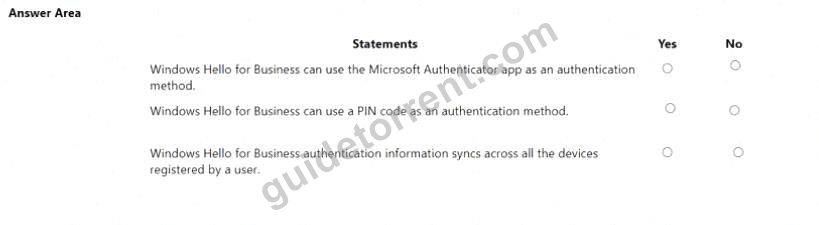
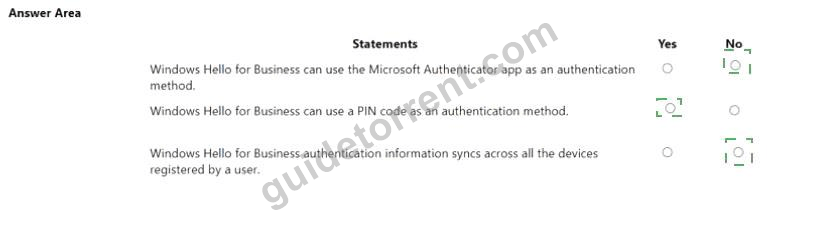
Correct Answer:
Explanation: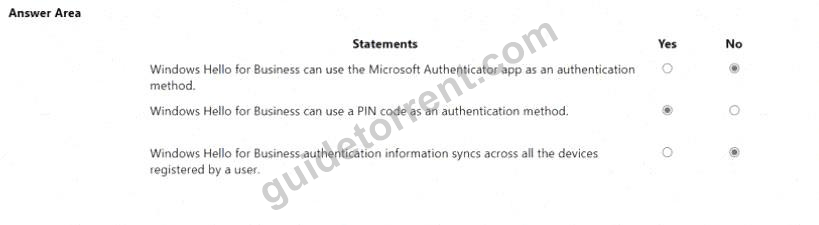
Microsoft describes Windows Hello for Business (WHfB) as replacing passwords with a device-bound credential: "Windows Hello for Business replaces passwords with strong two-factor authentication on devices. This authentication consists of a new type of user credential that is tied to a device and uses a biometric or a PIN." WHfB authenticators are biometric gesture or PIN unlocking an asymmetric key stored on the device (typically in the TPM). Microsoft clarifies that the PIN is not a password and is "local to the device" and used to unlock the user's private key. Consequently, Yes-a PIN is a supported WHfB sign-in gesture.
Conversely, the Microsoft Authenticator app is a separate Azure AD (Microsoft Entra ID) authentication method (push notifications, TOTP, passwordless phone sign-in). It is not the WHfB credential; WHfB relies on keys/certificates on the device, not on the Authenticator app.
Finally, WHfB credentials are per-device: Microsoft states the credential is "tied to a device" and the private key never leaves the device, which means it does not roam/sync across a user's different devices. Each device enrolls and provisions its own WHfB key and gesture. These statements from Microsoft SCI documentation lead to the outcomes: No / Yes / No.
文を正しく完成させる選択肢を選びなさい。
Correct Answer:

Explanation:
In Microsoft identity terminology, authentication is the step that proves who the user is when they attempt to sign in. Microsoft Learn defines it plainly: "Authentication is the process of proving the identity of a user, device, or service." By contrast, "Authorization is the process of determining what a user, device, or service can do." During sign-in to Microsoft Entra ID (formerly Azure AD), "the identity provider validates credentials and, upon successful authentication, issues tokens that applications use to grant access." Microsoft further explains the available methods: "Microsoft Entra ID supports multiple authentication methods, including passwords, multi-factor authentication, FIDO2 security keys, certificate-based authentication, and federated authentication." Auditing and administration are not the mechanisms that verify identity at sign-in. Auditing "records security- relevant events for investigation and compliance," while administration "refers to configuring and managing identities, access policies, and settings." Therefore, in the sentence "When users sign in, _____ verifies their credentials to prove their identity," the correct completion is authentication, because it is the control that validates the user's credentials and establishes identity before any authorization decisions are made.
文を正しく完成させる選択肢を選びなさい。
Correct Answer:

Explanation:
In Microsoft identity and access management terminology, federation refers to the establishment of a trust relationship between identity providers, which enables single sign-on (SSO) across different organizations or platforms.
According to the Microsoft Security, Compliance, and Identity (SCI) learning path, particularly in the SC-900 and SC-300 certifications, the following definition is provided:
"Federation is a means of establishing trust between two identity systems. This trust allows users from one domain to access resources in another domain without needing to authenticate again, typically using SAML, WS-Federation, or OAuth protocols." This concept is essential in cross-organization SSO scenarios, such as enabling users from one enterprise (or identity provider) to authenticate with services hosted in another, using existing credentials.
SCI documentation further states:
"Single sign-on (SSO) between multiple identity providers is enabled through federation protocols, which delegate authentication and allow token-based identity propagation across systems." The other options are not accurate in this context:
Integration is a vague term and not specific to SSO configuration.
Password hash synchronization and pass-through authentication are Azure AD authentication methods used for hybrid identity with on-premises AD, not for federating with external identity providers.
# Therefore, SSO configured between multiple identity providers is best classified as an example of federation.
Azure Key Vault を使用して実行できる 2 つの操作はどれですか?それぞれの正解は、完全な解決策を示しています。
注:正解ごとに1ポイントが加算されます。
- A. 秘密を保存する。
- B. 鍵を保管する。
- C. Azure DDoS保護を実装する。
- D. Azure Resource Manager (ARM) テンプレートを保存します。
- E. ネットワークセキュリティグループ(NSG)を実装します。
Correct Answer: A,B 🗳️
Explanation: Only visible for GuideTorrent members. You can sign-up / login (it's free).
Microsoft Entra IDガバナンスには、どの機能が含まれていますか?
- A. 個人情報保護
- B. 特権ID管理
- C. 権限管理
- D. 検証可能な資格情報
Correct Answer: B 🗳️
Explanation: Only visible for GuideTorrent members. You can sign-up / login (it's free).
Viewing page 1 out of 45 pages.
Viewing questions 1-5 out of 225 questions.


