
Get Special Discount Offer on Salesforce-MuleSoft-Developer-I Dumps PDF [UPDATED Nov-2025]
PDF Download Salesforce Test To Gain Brilliante Result!
Salesforce Salesforce-MuleSoft-Developer-I Exam Syllabus Topics:
| Topic | Details |
|---|---|
| Topic 1 |
|
| Topic 2 |
|
| Topic 3 |
|
| Topic 4 |
|
| Topic 5 |
|
| Topic 6 |
|
| Topic 7 |
|
| Topic 8 |
|
| Topic 9 |
|
NEW QUESTION # 12
An API specification is designed using RAML. What is the next step to create a REST Connector from this API specification?
- A. Download the API specification and build the interface using APIkit
- B. Publish the API specification to Any point Exchange
- C. Add the specification to a Mule project's src/main/resources/api folder
- D. Implement the API specification using flow designer in Design Center
Answer: B
Explanation:
API Exchange creates REST conenctor automtaically once API is published. Hence correct answer is Publish the API specification to Any point Exchange
NEW QUESTION # 13
Why would a Mule application use the ${http.port} property placeholder for its HTTP Listener port when it is deployed to CloudHub?
- A. Allows CloudHub to automatically change the HTTP port to allow external clients to connect to the HTTP Listener
- B. Allows clients to VPN directly to the application at the Mule application's configured HTTP port
- C. Allows CloudHub to automatically register the application with API Manager
- D. Allows MuleSoft Support to troubleshoot the application by connecting directly to the HTTP Listener
Answer: A
Explanation:
This helps CloudHub to dynamically allocates a port at deployment time.
MuleSoft Doc Ref : https://docs.mulesoft.com/mule-runtime/4.3/deploy-to-cloudhub#prerequisites
NEW QUESTION # 14
A Mule application's HTTP Listener is configured with the HTTP protocol. The HTTP listeners port attribute is configured with a property placeholder named http.port. The mule application sets the http.port property placeholder's value to 9090 The Mule application is deployed to CloudHub without setting any properties in the Runtime manager Properties tab and a log message reports the status of the HTTP listener after the Mule application deployment completes.
After the mule applications is deployed, what information is reported in the worker logs related to the port on which the Mule application's HTTP Listener listens?
- A. The HTTP Listener is listening on port 80
- B. The HTTP Listener is listening on port 9090
- C. The HTTP Listener is listening on port 8081
- D. The HTTP Listener failed to bind to the port and is not listening for connections
Answer: C
Explanation:
Cloudhub expose services on port 8081 and override value in http.port with this one .
Sample log in Runtime Manager is below
21:15:53.148 08/08/2021 Worker-0 ArtifactDeployer.start.01 INFO
Listening for connections on 'http://0.0.0.0:8081'
NEW QUESTION # 15
A web client submits a request to http://localhost:8081?accountType=personal. The query parameter is captured using a Set Variable transformer to a variable named accountType.
What is the correct DataWeave expression to log accountType?
- A. Account Type: #[message.inboundProperties.accountType]
- B. Account Type: #[vars.accountType]
- C. Account Type: #[flowVars.accountType]
- D. Account Type: # [attributes.accountType]
Answer: B
Explanation:
vars: Keyword for accessing a variable, for example, through a DataWeave expression in a Mule component, such as the Logger, or from an Input or Output parameter of an operation. If the name of your variable is myVar, you can access it like this: vars.myVar Hence correct answer is Account Type: #[vars.accountType]
NEW QUESTION # 16
According to MuleSoft. what is the first step to create a Modern API?
- A. Gather a list of requirements to secure the API
- B. Create an API specification and get feedback from stakeholders
- C. Create a prototype of the API implementation
- D. Performance tune and optimize the backend systems and network
Answer: B
Explanation:
First step in creating Modern API is to create an API specification and get feedback from stakeholders so that any future issues can be identified at early stage thereby reducing overall delivery time
NEW QUESTION # 17
Refer to the exhibits.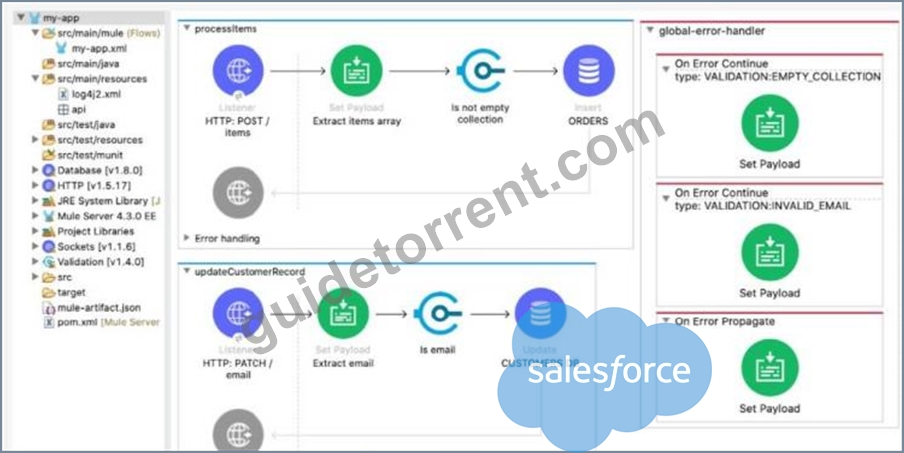

The my-app xml file contains an Error Handier scope named "global-error-handler" The Error Handler scope needs to be set to be the default error handler for every flow in the Mule application Where and how should the value "global-error-handler" be added in the Mule project so that the Error Handler scope is the default error handler of the Mule application?
- A. In the Validation folder as the value of a global element in the error-handling yaml file
- B. In the my-app.xml file, as an attribute of a configuration element
- C. In the mule-artifact json file, as the value of a key-value pair
- D. In the pom.xml file, as the value of a global element
Answer: B
NEW QUESTION # 18
A REST connect module is generated for a RAML specification. and then the rest connect module is imported in mule application in Anypoint Studio. For each method of the RAML specification , what does the REST connect module provide?
- A. A scope
- B. A flow
- C. An event source
- D. An operation
Answer: B
Explanation:
Correct answer is an operation. For each method of the RAML specification , REST connect module provide an operation.
Please refer to the below screenshot.
NEW QUESTION # 19
Refer to the exhibits.

Mule application has an HTTP request configuration where host name is hardcoded. Organization is looking to move host and port values to configuration file. What valid expression can be used to so that HTTP configuration can pick the value from configuration file?
- A. ${http.host}
- B. #[training.host]
- C. #{training.host}
- D. ${training.host}
Answer: D
Explanation:
Correct answer is ${training.host}
NEW QUESTION # 20
Refer to the exhibits. The webClient flow sends requests to the mockServer Row's HTTP Listener.
An HTTP: METHOD_NOT ALLOWED error is thrown each time the webClient flow executes.
What attribute value must be changed in the webClient flow's HTTP Request operation to prevent this error from being thrown?
- A. Change the protocol attribute's value to "HTTPS"
- B. Change the method attribute's value to "POSL
- C. Change the path attribute's value to 7api/partners/fastShopping"
- D. Change the method attribute's value to "*"
Answer: B
NEW QUESTION # 21
A RAML specification is defined to manage customers with a unique identifier for each customer record. What URI does MuleSoft recommend to uniquely access the customer identified with the unique ID 1234?
- A. /customers?operation=get&custid=1234
- B. /customers/1234
- C. /customers/custid=1234
- D. /customers?custid=true&custid=1234
Answer: B
Explanation:
URI parameter (Path Param) is basically used to identify a specific resource or resources . For eg : the URL to get employee details on the basis of employeeID will be GET /employees/{employeeID} where employees is resource and {employeeID} is URI parameter. Hence option 1is the correct answer
NEW QUESTION # 22
A Batch Job scope has five batch steps. An event processor throws an error in the second batch step because the input data is incomplete. What is the default behavior of the batch job after the error is thrown?
- A. Event processing continues to the next batch step.
- B. Batch is retried
- C. Error is ignored
- D. All processing of the batch job stops.
Answer: D
Explanation:
In case of an error , batch job completes in flight steps and stops further processing.
MuleSoft Doc Ref : Handling Errors During Batch Job | MuleSoft Documentation The default is all processing will stop but we can change it by Max Failed Record field.
General -> Max Failed Records: Mule has three options for handling a record-level error: Finish processing, Continue processing and Continue processing until the batch job accumulates a maximum number of failed records. This behavior can be controlled by Max Failed Records.
The default value is Zero which corresponds to Finish processing.
The value -1, corresponds to Continue processing.
The value +ve integer, corresponds to Continue processing until the batch job accumulates a maximum number of failed records
NEW QUESTION # 23
Which of the below is used by Mule application to manage dependencies which make sharing the projects lightweight and easier?
- A. POM.xml
- B. Global element
- C. Configuration file
- D. Cloudhub
Answer: A
Explanation:
POM.xml contains info about the project and configurationn details used by Maven to build the project
NEW QUESTION # 24
Refer to the exhibits. What payload is logged at the end of the main flow?
- A. [order1, order2, order3, order4]
- B. order4
- C. order1order2order3order4
- D. [1, 2, 3, 4]
Answer: D
Explanation:
For Each Scope
The For Each scope splits a payload into elements and processes them one by one through the components that you place in the scope. It is similar to a for-each/for loop code block in most programming languages and can process any collection, including lists and arrays. The collection can be any supported content type, such as application/json, application/java, or application/xml.
General considerations about the For Each scope:
By default, For Each tries to split the payload. If the payload is a simple Java collection, the For Each scope can split it without any configuration. The payload inside the For Each scope is each of the split elements. Attributes within the original message are ignored because they are related to the entire message.
For Each does not modify the current payload. The output payload is the same as the input.
Mule Doc Reference : https://docs.mulesoft.com/mule-runtime/4.3/for-each-scope-concept
NEW QUESTION # 25
An API implementation has been deployed to CloudHub and now needs to be governed. IT will not allocate additional vCore for a new Mule application to act as an API proxy.
What is the next step to preseive the current vCore usage, but still allow the Mule application to be managed by API Manager?
- A. Modify the API implementation to use auto-discovery to register with API Manager
- B. Register the same API implementation in Runtime Manager to connect to API Manager
- C. Upload the Mule application's JAR file to the API instance in API Manager
- D. Deploy the same API implementation behind a VPC and configure the VPC to connect to API Manager
Answer: A
Explanation:
Correct answer is Modify the API implementation to use auto-discovery to register with API Manager API Autodiscovery Configuring autodiscovery allows a deployed Mule runtime engine (Mule) application to connect with API Manager to download and manage policies and to generate analytics data. Additionally, with autodiscovery, you can configure your Mule applications to act as their own API proxy.
When autodiscovery is correctly configured in your Mule application, you can say that your application's API is tracked by (green dot) or paired to API Manager. You can associate an API in a Mule setup with only one autodiscovery instance at a given time.
MuleSoft Doc Ref : https://docs.mulesoft.com/api-manager/2.x/api-auto-discovery-new-concept
NEW QUESTION # 26
A Mule project contains a DataWeave module file WebStore dvA that defines a function named loginUser The module file is located in the projects src/main/resources/libs/dw folder What is correct DataWeave code to import all of the WebStore.dwl file's functions and then call the loginUser function for the login "[email protected]"?
A)
B)
C)

- A. Option B
- B. Option C
- C. Option A
- D. Option D
Answer: D
NEW QUESTION # 27
What is the purpose of the api:router element in APIkit?
- A. Validates responses returned from API requests and routes them back to the caller
- B. Creates native connectors using a 3rd party Java library
- C. Validates requests against RAML API specifications and routes them to API implementations
- D. Serves as an API implementation
Answer: C
Explanation:
The APIkit Router is a key message processor that validates requests against the provided definition, enriches messages (for example by adding default values to the messages) and routes requests to a particular flow. Also, the Router raises errors messages if errors occurs while routing, validating or processing the user request.
NEW QUESTION # 28
Refer to the exhibits.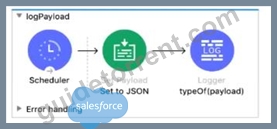

A JSON payload is set in the Set Payload transformer.
What is logged by the Logger?
- A. "JSON"
- B. "String"
- C. "Object"
- D. "Array"
Answer: D
NEW QUESTION # 29
Refer to the exhibits. The Mule application does NOT define any global error handlers.
A web client sends a POST request to the Mule application with this input payload. The File Write operation throws a FILE: CONNECTIVITY error.
What response message is returned to the web client?
- A. "ORDER: NOT CREATED"
- B. "OTHER ERROR"
- C. "FILE: CONNECTMTV
- D. "File written"
Answer: A
NEW QUESTION # 30
Refer to the exhibit.
The main flow contains a Flow Reference for the child flow.
What values are accessible in the child flow after a web client submits a request to http://localhost:8Q81/order? color=red?
- A. payload
quantity var - B. payload
color query param - C. payload
quantity var color query param - D. payload
Answer: C
Explanation:
Flow Reference Component
Flow Reference routes the Mule event to another flow or subflow, executes all processors in the referenced flow, and then routes the event back within the same Mule application. The following diagram shows the order of processing when one flow references another:
When the main flow is triggered, the Mule event travels through and executes the flow until the event reaches the Flow Reference. The event then travels through and executes the referenced flow from beginning to end, and then returns to the main flow.
This process enables you to treat the entire referenced flow like a single component in your current flow.
Mule Ref Doc : https://docs.mulesoft.com/mule-runtime/4.3/flowref-about Correct answer is payload quantity var color query param
NEW QUESTION # 31
Which Mule component provides a real-time, graphical representation of the APIs and mule applications that are running and discoverable?
- A. API Notebook
- B. Anypoint Visualizer
- C. API Manager
- D. Runtime Manager
Answer: B
Explanation:
Correct answer is Anypoint Visualizer
MuleSoft Doc Ref : https://docs.mulesoft.com/visualizer/
Anypoint Visualizer provides a real-time, graphical representation of the APIs, and Mule applications that are running and discoverable. It also displays third-party systems that are invoked by a Mule API, proxy, or application within your application network. The data displayed in the graph is dynamically updated and does not require prior configuration. Additionally, the data displayed is secure, as only users with the proper permissions can view the application network graph.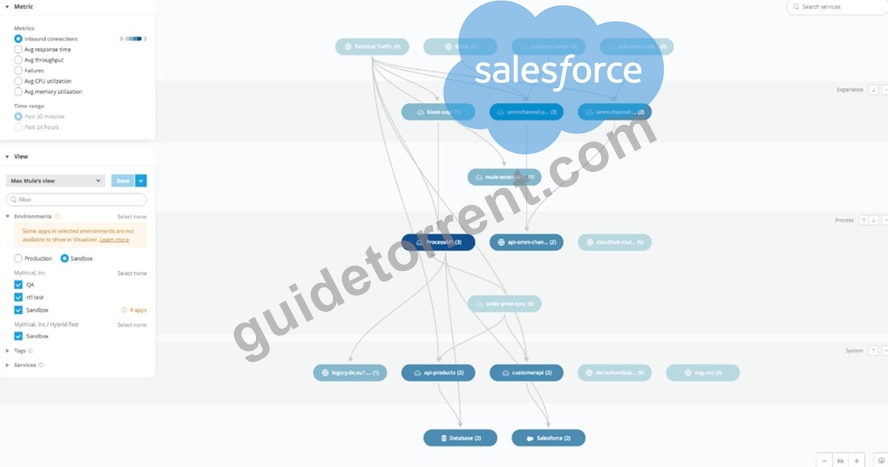
NEW QUESTION # 32
A Utlility.dwl is located in a Mule project at src/main/resources/modules. The Utility.dwl file defines a function named encryptString that encrypts a String What is the correct DataWeave to call the encryptString function in a Transform Message component?
- A. 1. %dw 2.0
2. output application/json
3. import modules::Utility
4. ---
5. encryptString( "John Smith" ) - B. 1. %dw 2.0
2. output application/json
3. import modules.Utility
4. ---
5. encryptString( "John Smith" ) - C. 1. %dw 2.0
2. output application/json
3. import modules::Utility
4. ---
5. Utility::encryptString( "John Smith" ) - D. 1. %dw 2.0
2. output application/json
3. import modules.Utility
4. ---
5. Utility.encryptString( "John Smith" )
Answer: A
Explanation:
Correct answer is
%dw 2.0
output application/json
import modules::Utility
---
Utility::encryptString( "John Smith" )
DataWeave 2.0 functions are packaged in modules. Before you begin, note that DataWeave 2.0 is for Mule 4 apps. For Mule 3 apps, refer to DataWeave Operators in the Mule 3.9 documentation. For other Mule versions, you can use the version selector for the Mule Runtime table of contents.
Functions in the Core (dw::Core) module are imported automatically into your DataWeave scripts. To use other modules, you need to import the module or functions you want to use by adding the import directive to the head of your DataWeave script, for example:
import dw::core::Strings
import camelize, capitalize from dw::core::Strings
import * from dw::core::Strings
The way you import a module impacts the way you need to call its functions from a DataWeave script. If the directive does not list specific functions to import or use * from to import all functions from a function module, you need to specify the module when you call the function from your script. For example, this import directive does not identify any functions to import from the String module, so it calls the pluralize function like this: Strings::pluralize("box").
Transform
%dw 2.0
import dw::core::Strings
output application/json
---
{ 'plural': Strings::pluralize("box") }
Salesforce-MuleSoft-Developer-I Dumps are Available for Instant Access: https://lead2pass.guidetorrent.com/Salesforce-MuleSoft-Developer-I-dumps-questions.html